History of Arcade Games: How Coin-Operated Classics Shaped a Century of Play
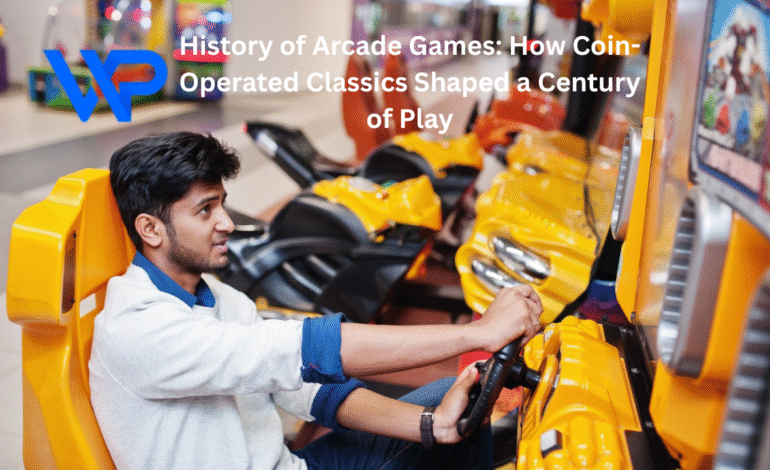
The history of arcade games is also the history of modern gaming itself. Before consoles took over living rooms and long before online multiplayer became the norm, arcade machines were the heart of gaming culture. These machines glowed from dark corners of malls, amusement halls, and smoky rooms where teenagers gathered with pockets full of coins and dreams of landing at the top of the leaderboard. Even now, remembering arcades brings back a powerful nostalgia that feels almost like time travel. Yet the real story behind arcades begins not in the but decades earlier, in places that looked nothing like the gaming centers people remember so fondly.
Arcade History: From Mechanical Curiosities to Early Coin-Op Entertainment
When studying arcade history, it becomes clear that gaming did not begin with computers. Instead, early amusement halls of the late 19th and early 20th centuries were filled with mechanical novelty machines. Visitors paid a penny to test their grip, watch a short film, listen to a phonograph, or view simple moving pictures inside kinetoscopes and mutoscopes. These machines were basic, but they introduced a groundbreaking idea: entertainment could be short, exciting, and activated by inserting a coin. This was the earliest spark of what would eventually become the arcade industry.
As technology advanced, these attractions became more sophisticated. Mechanical shooting games, strength testers, and fortune-telling machines grew increasingly popular. But nothing transformed amusement halls quite like pinball. By the 1930s, pinball machines were everywhere. Their flashing lights, colorful scoring tables, and addictive gameplay created a cultural phenomenon that shaped the social environment of early arcades. Even when certain cities attempted to ban pinball because of misplaced concerns about gambling, the game only became more iconic. For several decades, pinball was the defining feature of arcades and set the stage for what digital gaming would later become.
Evolution of Arcade Games: How Digital Screens Reshaped the Industry
The evolution of arcade games took a dramatic leap forward in the 1960s. In 1962, an MIT student named Steve Russell created Spacewar!, one of the earliest digital games ever programmed. Although not commercially available, it sparked the idea that computers could offer new forms of entertainment. This concept caught the attention of innovators across the country. Soon after, students at Stanford University built Galaxy Game, the first coin-operated computer game. Around the same time, Nolan Bushnell and Ted Dabney constructed Computer Space, the first commercial arcade video game.
Computer Space struggled to gain mainstream attention because of its complexity, but it proved an essential point: people would pay to play video games. The true breakthrough came in 1972 when Atari released Pong, a simple table-tennis simulation with two paddles and a bouncing square. Pong machines drew huge crowds, and for the first time, digital gameplay felt accessible to everyone. Developers immediately began experimenting, and a surge of early arcade video games appeared, including early arcade racing games, early arcade fighting games, and even Breakout, an early arcade game created by Steve Jobs and Steve Wozniak. These developments laid the groundwork for the arcade explosion that soon followed.
History of Arcade Games Globally: The Golden Age Begins
The most celebrated period in the history of arcade games globally began in the late 1970s and lasted through the mid-1980s. This was the era that shaped childhoods, created lifelong fandoms, and transformed video games into a cultural force. The turning point came in 1978 when Taito released Space Invaders. The game ignited a global obsession. People lined up to defend Earth from descending alien formations, and arcades filled with excited players waiting their turn. Its success convinced companies everywhere that video games were not a fad—they were the future.
Within just a few years, arcades became cultural landmarks. Titles such as Pac-Man, Donkey Kong, Galaga, Frogger, Centipede, and Dragon’s Lair filled arcades around the world. These games didn’t just entertain players; they introduced memorable characters, iconic music, and new forms of gameplay. Pac-Man became the first worldwide gaming mascot, while Donkey Kong launched the career of Mario, a character whose legacy endures to this day.
Anyone who browses an early 80s arcade games list today sees an era packed with creativity and innovation. Arcades were social spaces filled with laughter, competition, and the hard clatter of coins falling into metal slots. For many, this was the birthplace of gaming as they knew it.
Arcade Classic Game Culture: A Personal Memory of High Scores and Community
The culture surrounding the arcade classic game era was as important as the games themselves. One player recalled standing at a Pac-Man machine in 1982, trying to beat the local high score. As his score climbed higher, players gathered behind him. He described how his hands shook—not because the game was difficult but because, for the first time, people were cheering him on. When he finally topped the leaderboard, strangers clapped and congratulated him. That moment stayed with him for decades.
These experiences were common. Arcades were some of the first public places where skill, practice, and intuition mattered more than age, background, or popularity. They created communities long before the internet existed.
Early Arcade Games Used a Vector Graphics Display: Visual Innovation Takes Shape
While many early games used pixel graphics, others relied on a different approach known as vector displays. Titles like Asteroids and Battlezone used bright lines instead of filled shapes, producing crisp visuals that felt futuristic compared to the blocky sprites found elsewhere. This innovation shaped a new category of early arcade video games and influenced future design in both arcades and home systems.
Arcade Game 1985 and Arcade Game 1988: Mid-80s Milestones
If you look at any catalog of games such as an arcade game 1985 or arcade game 1988 collection, you see how rapidly the technology evolved. Games like Gauntlet, Paperboy, and Double Dragon added narrative elements and cooperative play. These mid-1980s advancements pushed arcades far beyond simple reflex-based gameplay. The cabinets themselves became more elaborate as well, including motorcycle simulators, cockpit-style racing games, and immersive shooters that offered experiences players could not replicate at home.
This era showed how creative the arcade industry could be when competition was fierce and innovation was constant.
History of Arcade Fighting Games: The Rise of Competitive Culture
A new revolution began in the early 1990s with the rise of arcade fighting games. Capcom’s Street Fighter II, released in 1991, changed everything. Instead of playing alone, players faced each other in intense, skill-based battles. This competitive format brought crowds together, fuelled rivalries, and created one of the earliest forms of eSports.
Titles like Mortal Kombat, Tekken, and King of Fighters soon followed, each adding new mechanics and expanding the fighting-game community. Arcades became arenas of strategy, reflexes, and bragging rights. The energy around fighting games breathed new life into arcades at a time when home consoles were beginning to rise in popularity.
Arcade Historical Impact: A Rise, Decline, and Unexpected Comeback
By the mid-1990s, arcade attendance began to decline. Home consoles such as the Super Nintendo, Sega Genesis, and later the PlayStation offered long, complex games at home without requiring a pile of coins. As access to home gaming increased, many arcades struggled to survive.
This led many people to ask: do arcade games still exist?
They do—just in new forms. The modern arcade has reinvented itself through barcades, nostalgia-driven retro centers, and family entertainment venues. International markets such as arcade games Pakistan and cities like Hyderabad Sindh have preserved smaller local arcade cultures, showing how global the influence truly is.
Meanwhile, collectors and enthusiasts continue to revive and preserve machines, ensuring that classic cabinets are never forgotten.
History of Arcade Games and Sports: A Unique Blend
In some regions, the history of arcade games and sports merged into a single culture. Basketball shooters, cricket simulators, and football-themed machines became common in venues that blended athletic energy with gaming excitement. This hybrid culture played a notable role in places like Pakistan, where arcades adapted to local interests.
Early Arcade Game Created by Steve Jobs and Steve Wozniak
An often overlooked part of arcade history is the role that Steve Jobs and Steve Wozniak played. The founders of Apple collaborated with Atari to develop Breakout, a game that inspired a generation of designers and appeared in countless arcades and home systems. The fact that such iconic tech pioneers contributed to the history of arcade games shows how closely gaming and computing evolved together.
History of Arcade Games Article, Research, and Academic Study
Interest in arcades extends far beyond casual nostalgia. Many researchers and historians study their development. Searches such as history of arcade games Google Scholar, history of arcade games journal, or history of arcade games journal article lead to scholarly work examining the social, cultural, and technological impact of arcades. Graphs charting arcade popularity—referred to as history of arcade games graph data—are used to analyze shifts in public entertainment and consumer habits.
Books like history of arcade games book editions and compilations exploring history of arcade games globally play a major role in preserving these stories for future generations.
Facts About Arcade Games: Why They Still Matter
Even now, the influence of classic arcades can be seen everywhere in modern gaming. Many mechanics we take for granted—timers, high scores, boss battles, and “lives”—originated in arcades. The competitive nature of arcade play paved the way for modern tournaments and eSports. Perhaps most importantly, arcades fostered a sense of community. Before the internet existed, arcades were gathering places where players learned, competed, and celebrated together.
This emotional connection is one reason nostalgia for arcades continues to grow, and why retro-inspired games remain so popular today.
History of Arcade Games and Events: A Timeline in Motion
Although the narrative of arcades spans a century, the defining events follow a clear arc. Early mechanical amusements introduced coin-operated entertainment. Pinball machines brought flair and skill into public spaces. The arrival of Pong and early video games marked a monumental shift that led to the Golden Age. After years of innovation and competition, the decline began as consoles grew stronger. Yet arcades found new life through nostalgia, themed venues, and digital preservation.
The result is an industry that refuses to disappear, continually reinventing itself for new audiences.
Conclusion: The Arcade Lives On in Memory and Modern Culture
The history of arcade games is much more than a sequence of machines. It is a story about people—those who built the games, those who played them, and those who continue preserving them. Arcades shaped the earliest form of gaming culture, creating friendships, rivalries, and moments of triumph that live on decades later. Even though traditional arcades are not as widespread as they once were, their spirit can be felt in every retro console, every barcade, and every digital high score earned today.